
Blog
How to Choose a Yixing Clay Teapot (Without Buying a Fake)


Table of Contents
A genuine Yixing clay teapot can elevate Gongfu tea from a simple beverage into a profound sensory experience by softening bitterness and enhancing aroma. However, the market is flooded with mass-produced fakes, making it easy for beginners to fall victim to scams when shopping for authentic Chinese tea sets.
This guide provides actionable steps, backed by expert advice, to help you identify and purchase a real Yixing clay teapot.
4 Essential Steps: How to Choose a Yixing Teapot for Your Needs
Step 1: Match the Clay Type to Your Favorite Tea
The micro-porous structure of Yixing clay absorbs tea oils, making the “one pot, one tea” rule essential for your traditional tea sets.
| Clay Type | Characteristics | Best Paired With |
| Zi Ni (Purple Clay) | Mellow texture, steady color, highly breathable, widely adaptable to different teas, easy to season. | Lightly roasted teas: Green tea, black tea, oolong tea, dark tea, yellow tea, white tea. |
| Zhu Ni (Red Clay) | Denser clay nature, excellent breathability, preserves aroma, stimulates tea fragrance, and purifies the tea liquor. | Highly fragrant teas: Pu-erh, Tieguanyin. |
| Duan Ni (Yellow Clay) | Appears light yellow or beige. It has a stronger granular sandy texture. | Lighter teas: Green tea, oolong tea, dark tea. |
| Lu Ni (Green Clay) | Good breathability, fast heat dissipation, preserves the original flavor of the tea leaves. | Green tea, oolong tea, yellow tea, white tea. |

For Beginners: Choose the Zi Ni (Purple clay) series; it is easy to maintain and pairs well with a wide range of teas.
For Advanced Drinkers: Choose Zhu Ni to experience the delicate interaction between the premium clay and the tea liquor.
How to brew tea with a teapot? Please read: The Best Guide on How to Make Tea in a Teapot
Step 2: Pick the Right Size for Your Brewing Style
Choosing capacity based on the number of people is the easiest method.
Many people think a large teapot can brew more tea and is convenient for hosting guests.
However, using a large pot for just one person leads to severe tea waste and an uneven concentration of the tea liquor.
For Gongfu tea brewing, the first three steeps become too strong, and the later steeps become too weak, resulting in a poor experience.
- Solo drinking, tasting high-aroma teas: 80~120cc small clay teapot.
- Daily drinking for 1~2 people: 130~220cc medium clay teapot.
- Gatherings of 3~5 people, office use: 230~350cc large clay teapot.
Large gatherings, boiling tea, or distributing tea: 350cc+ extra-large teapot/fairness cup (Gongdao Bei).
Step 3: Check the Shape and Pour Dynamics
A fast pour is crucial for controlling steeping times in Gongfu tea sets.
- Xishi Teapot: The short, straight spout provides a crisp pour; the round shape is comfortable to hold and prevents burning your hands.
- Shipiao Teapot: The triangular shape gives it a low center of gravity for a powerful pour, and the wide mouth makes adding leaves and cleaning easy.
- Fanggu Teapot: The wide and deep body ensures a smooth water flow and a clean cut-off; it provides ample space for tea leaves to expand, and the large opening is convenient for cleaning.
Want to know more about teapot pouring issues? Please read: Guide to Perfect Yixing Teapot Pour: Stop Dripping and Sputtering
Step 4: Assess the Craftsmanship
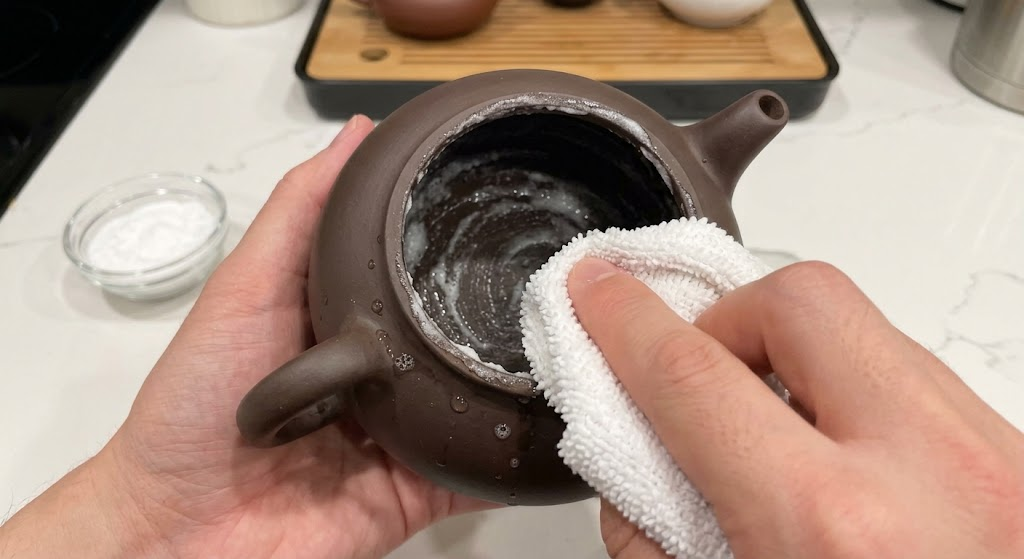
Fully Handmade Yixing Clay Teapot: The inner walls have natural, irregular shrinkage lines and horizontal joining marks (mostly at 1/3 of the body); the clay structure is tight outside and loose inside, with particles showing a sense of compression.
Half-Handmade Yixing Clay Teapots: The inner walls may show neat “pushing the wall and scraping the bottom” marks (to hide mold seams), with seam lines usually found under the handle.
A solid, well-crafted half-handmade teapot is the best entry-level choice for beginners exploring authentic Yixing teapot.
Spotting Fakes: Are You Buying Authentic Yixing Clay Teapot?
One often sees people on Reddit asking whether their Yixing teapots are authentic; experts say that authenticity can be verified through price, as well as visual, tactile, and auditory cues.
The $100 Rule of Thumb
Fully Handmade: Formed entirely by hand-paddling, requiring 36 core steps and a 7-15 day cycle.
Half-Handmade: Assisted by plaster molds, efficiency is 3-5 times faster than fully handmade, but the spout and handle still require manual finishing.
Due to the scarcity of pure ore clay and the high labor costs of fully or half-handmade craftsmanship, a genuine zisha teapot rarely costs under $100. Cheaper options are usually chemical-laced fakes.
Want to understand the craftsmanship of Yixing teapots? Please read: The Art of Zisha Teapot Making——What No One Tells You
Visual and Tactile Cues
- Check the Seams:
Look for clay joining marks inside, rather than horizontal wheel-thrown lines. The transition between the Chinese yixing teapot body and the spout should be seamless and smooth.

- Check the Texture:
Authentic Zisha contains mica and iron melt spots, possessing a natural sandy feel on the surface. Fired pure ore Zisha has a matte finish and will never be glaringly smooth like glass.
- Check the Color:
The color of pure ore Zisha clay will never look as saturated and glaring as a plastic toy.
If you see a teapot that is apple-red, emerald-green, or ink-black, with a uniform color throughout and no depth or shading—put it down immediately and don’t look back.
The “Sound Test” Myth and Reality
When tapped, a genuine Yixing zisha clay teapot produces a crisp, pleasant sound, while fake teapots often sound muffled or discordant.
A common misconception is that a crisp, porcelain-like sound solely defines authenticity; it usually indicates a high firing temperature (like with Zhu Ni) and should not be used as the only standard to spot fake Yixing clay.
Where to Buy Reliable Yixing Clay Teapot
Bypassing middlemen and sourcing directly from a brand whose primary base is in China ensures an authentic origin and strict quality control.
At OURIOO, our direct supply chain allows us to provide rigorously vetted, traditional tea sets and Gongfu tea accessories to our communities in the US and Europe, eliminating the uncertainties of cross-border online shopping.
FAQ
Can you use any tea in a Yixing clay teapot?
It is best to dedicate one specific zisha teapot to one type of tea. The porous clay absorbs flavors, so mixing different tea leaves will negatively affect the taste.
What type of tea pairs best with Zhuni clay?
Highly fragrant teas, such as Tieguanyin and light Oolong tea, pair best because the dense texture of Zhu Ni perfectly preserves the delicate aroma of the tea.



One thought on “How to Choose a Yixing Clay Teapot (Without Buying a Fake)”