Blog
How Much Tea Is in a Gaiwan? The Perfect Gongfu Ratios

Table of Contents
How much tea is in a gaiwan? Mastering the proper gaiwan tea to water ratio is the ultimate secret to unlocking the mellow and complex flavors of gongfu tea. Whether you are brewing a delicate silver needle white tea or a robust pu erh, brewing with a gaiwan set is completely different from tossing a tea bag straight into a mug.
In this guide, we will detail the exact grams of tea leaves, the golden ratios, and professional tips to help you brew a perfect cup every time.
Understanding the Standard Gaiwan Size
Before discussing tea leaves, we first need to understand the teaware. A standard gaiwan tea set typically holds 100 ml to 150 ml of water. But why is it so small?
Gaiwan vs Teapots
- Material and Flavor Retention:
A porcelain gaiwan is clean, transparent, and non-porous (does not absorb odors). It can brew different types of tea.
Teapots are mostly made of Yixing clay or pottery, which have good breathability and retain fragrance. They are not suitable for brewing different types of tea in the same pot.
- Thermodynamics:
A gaiwan has a wide opening, dissipates heat quickly, and pours smoothly, resulting in a crisper tea soup style.
A teapot has a smaller opening, dissipates heat slower, keeps warm longer, and pours slower.

Why 100ml-150ml is the Sweet Spot for Gongfu Tea
In the gongfu tea ceremony, its essence lies in enjoying multiple short infusions rather than one over-steeped large brew.
A gaiwan size of 100 ml to 150 ml is just right: it is small enough to be comfortably held with one hand, yet large enough to allow tightly rolled loose leaf tea (such as Oolong tea) to fully expand and release its complex flavors over 5 to 10 infusions.
This is also highly recommended in the comprehensive how to brew gongfu tea guide published by My Tea Explorer (which synthesizes data from top tea masters).
OURIOO Recommend: Elevate Your Gongfu Ritual
Diameter 9 cm | Height 7.9 cm | Capacity 100 ml
100ml golden small capacity, specially designed for delicate gongfu tea brewing.
Fired at 1300°C, the high-density porcelain body provides ultimate heat lock.
Natural snowflake crystalline glaze with natural kiln transformation; each piece is unique.
Stable center of gravity for precise and crisp pouring.
Diameter 9 cm | Height 8.3 cm | Capacity 110 ml
110ml perfect volume control.
Premium bone porcelain body, lightweight and tough.
999 pure silver interior coating instantly softens the water quality.
Hand-painted magpie and winter plum blossom, displaying Eastern luxury.
Withstands high-frequency brewing, offering the dual enjoyment of gathering fragrance and enhancing sweetness.
Diameter 9.2 cm | Height 9 cm | Capacity 140 ml
140ml generous capacity, effortlessly achieving the 1:15 golden gaiwan tea to water ratio.
Robust thickened porcelain body provides excellent heat retention load.
Vintage duck-egg blue glaze with hand-painted rich peony.
Anti-scald flared lip design makes every pour graceful and elegant.
Diameter 13.4 cm | Height 8.6 cm | Capacity 150 ml
150ml large capacity, suitable for brewing large tea leaves.
Stunning amber tortoiseshell kiln-fired glaze with distinct black and brown layers.
Authentic Jizhou high-temperature kiln-fired ceramic with outstanding heat storage and retention.
Ergonomic anti-scald design with a seamlessly fitting lid.
Silky smooth water flow control, easily mastered even by beginners.
Want to know the optimal gaiwan size for different numbers of people? Read: Perfect Brew: What is the Best Size for a Chinese Gaiwan?
How Many Grams of Tea Leaf Do You Need for a Gaiwan?
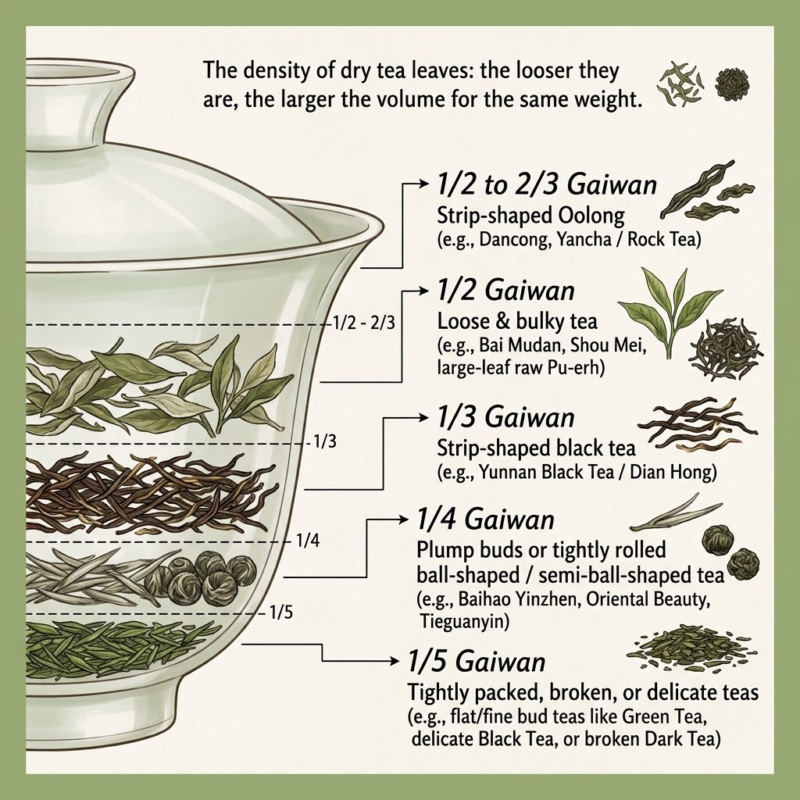
A gaiwan tea set is suitable for brewing most types of tea. The core is “matching the amount of tea to the capacity”; otherwise, problems can easily occur. How do you accurately measure tea without a digital scale? Here is an example based on a 110ml gaiwan:
White Tea and Green Tea (Lighter Teas)
- White Tea: For fluffy types (Shou Mei, Gong Mei), fill the entire gaiwan; for tender types (Silver Needle), fill 1/4 to 1/3.
- Green/Yellow Tea: Similar in shape, taking Maojian as an example, filling to 1/5 of the gaiwan is sufficient.
- Tea to Water Ratio: 1:25. These delicate tea leaves need a larger brewing space and slightly cooler water temperature to avoid bitterness after brewing.
Oolong Tea: Rolled vs. Twisted Leaves
- Oolong Tea: Slow release requires more leaves. For twisted, long leaves like Phoenix Dancong and Wuyi Rock Tea, fill 2/3 full; for tightly rolled pellet types like Tieguanyin, fill 1/3 to 1/4.
- Tea to Water Ratio: 1:15. Oolong tea has a rich flavor and requires a higher leaf density to achieve its signature thick, aromatic tea liquor.
Pu-erh and Black Teas
- Black Tea: For fine strips (Keemun, Jin Jun Mei), fill 1/5; for broad-leaf robust types (Dianhong), fill 1/4 to 1/3.Tea to water ratio: For a 110ml gaiwan, use 5g of black tea. The 1:22 ratio makes the aroma mellow and not bland.
- Dark Tea: For compressed types (Pu-erh cakes), simply covering the bottom of the gaiwan is enough; for loose tea, fill about 1/3.
- Tea to Water Ratio: Black tea is around 1:20 to 1:22, which yields a rich and sweet aroma without bitterness. For Pu-erh tea, 1:15 will highlight its mellow earthy notes.
Leaf-to-Water Ratio: The Secret to Using a Gaiwan Tea Set
Too much water and too little tea will taste flat, while too much tea and too little water will easily become bitter. Finding the right ratio is the foundation for unlocking the best flavor of the tea leaves.
The General 1g per 15ml Rule
As recently discussed by the Reddit r/tea community and agreed upon by many veteran tea drinkers, the commonly used ratio range for brewing with a gaiwan is between 1:15 and 1:20.
This ratio means that for every 1 gram of tea, 15 to 20 milliliters of water are paired. The formula is very simple:
- Universal Formula and Calculation
Tea Amount (grams) ≈ Gaiwan Size (ml) ÷ Ratio Denominator
For example, for a 110ml gaiwan, using a 1:15 ratio: 110 ÷ 15 ≈ 7.3 grams.
If your gaiwan is 150ml, using a 1:20 ratio requires about 7.5 grams of tea.
The core principle is: the larger the gaiwan capacity, the more tea you should add.
Gongfu Tea Calculator
Find the perfect tea amount for your gaiwan.
Adjusting Steeping Times Based on Your Ratio
Because gongfu tea brewing utilizes a higher leaf-to-water ratio, the tea must be steeped for a very short time—often referred to as “flash steeping.”
First infusion: 10 to 15 seconds.
Subsequent infusions: Add 5 to 10 seconds for each additional steep.
If your tea tastes too bitter, do not necessarily reduce the tea amount; try pouring the water out faster!
Want to know how to use a gaiwan set? Read: How to Use Gaiwan Tea Set: Best Guide to Brewing Gongfu Tea
Does the Material Matter? Porcelain vs. Clay Gaiwan
When shopping for teaware, you will find that gaiwans come in materials like glass, clay, and porcelain.
Why a Porcelain Gaiwan Tea Set is Ideal for Beginners
A porcelain gaiwan set is the industry standard for tea tasting.
Because it is glazed and fired at high temperatures, it is completely non-porous, meaning it will not absorb the aroma of rich Pu-erh tea, nor will it transfer it to light green tea.
A gaiwan tea set is easy to clean, and the stark white interior makes it easy for you to accurately judge the color of the tea liquor.
How Material Affects Heat Retention and Tea Capacity
A porcelain gaiwan has moderate heat retention.
It dissipates heat at a moderate pace, neither scorching delicate green and white teas nor losing enough heat to prevent tightly rolled oolongs from expanding.
If you use a thicker pottery or stoneware gaiwan, although it looks large on the outside, the thick walls will reduce the actual water capacity—so always measure the interior capacity!
Want to understand the impact of gaiwan thickness? Read: Gaiwan – Thick or Thin? How to Choose for Your Tea Ceremony
Common Mistakes When Filling Your Gaiwan
Gaiwan takes some practice. Here are the two most common mistakes beginners make when pouring water.
Overfilling: Escaping the “Burnt Fingers” Trap
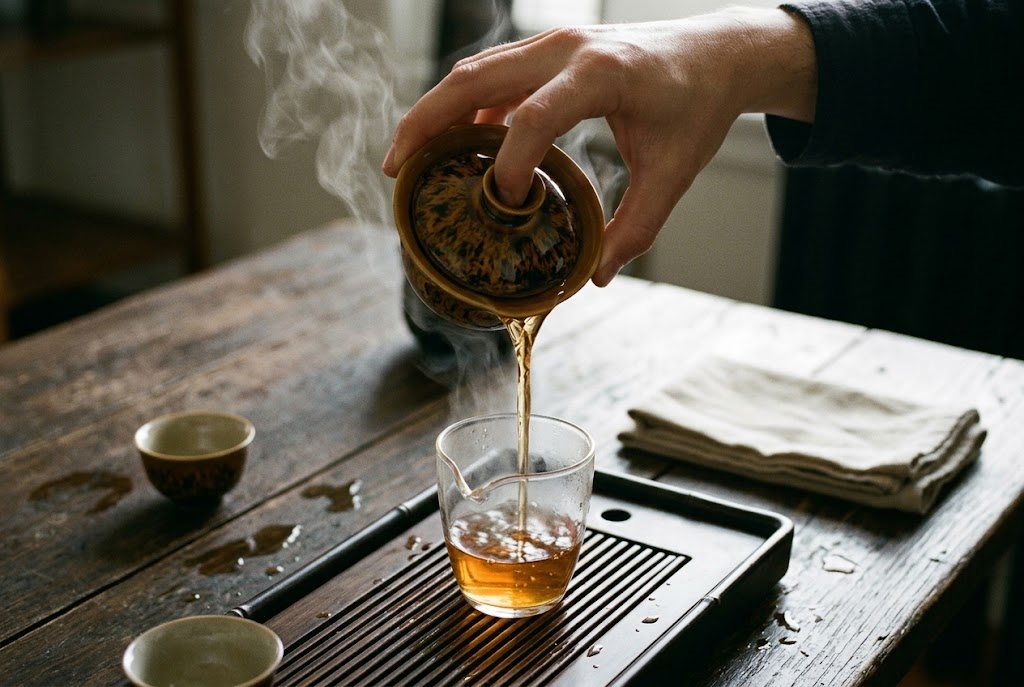
The most common mistake is filling it all the way up.
When you put the lid on, the boiling water spills over and scalds the flared lip.
When you try to pick up the cup, it is easy to burn your fingers or even drop the cup on the floor!
The Fix: Only add water to the point where the lid just rests at the base. Keep the flared lip completely dry. This lip is your “safe zone” to protect your fingers.
Under-leafing: Why Your Tea Tastes Weak
Because Western mugs hold over 300ml, beginners often underestimate the amount of tea required for a 110ml gaiwan.
If you only put a tiny pinch of leaves (2 grams) into the gaiwan, the quick-brewed tea liquor will taste as bland as hot water.
Remember the 1:15 tea to water ratio, pack the tea leaves in, and pour quickly!
Master Your Brew with the Right Tools
Mastering the amount of tea in a gaiwan comes down to understanding the 1:15 tea ratio, knowing the tea types, and practicing flash steeping times. Once you get the hang of it, you can extract unparalleled rich flavors.
Ready to elevate your tea-tasting experience? Explore OURIOO’s traditional gaiwan collection today, and start brewing like a true gongfu master!
FAQ
What size should a gaiwan be?
The standard gaiwan size suitable for daily gongfu tea brewing is usually between 100ml and 150ml.
Can you use a gaiwan for any tea?
Yes, especially non-porous porcelain gaiwans, which do not absorb tea flavors and are perfectly suited for brewing almost all types of whole leaf tea.