

Blog
Yixing Teapot Slow Pour? How to Fix Poor Water Flow

Table of Contents
Nothing disrupts a peaceful Gongfu tea session faster than a Yixing teapot that dribbles, sputters, or takes ten seconds to empty. In high-leaf-ratio brewing, a sluggish pour isn’t just annoying—it over-steeps your tea and turns sweet, balanced infusions bitter.
Most slow-pour issues are caused by clogged filters, blocked airflow, or leaf-to-filter mismatch—not a ruined pot. Below, we’ll diagnose the exact cause and walk through safe, clay-friendly ways to get your zisha teapot pouring like new.
Why Your Yixing Clay Teapot Pours Slowly
Ever since potters in China’s Yixing district adapted stoneware vessels for steeping loose tea leaves in the sixteenth century, smooth water flow has been a core benchmark of functional teaware. When a yixing clay teapot suddenly slows down, the problem almost always falls into one of three areas.
Tea Leaves Blocking the Teapot Filter
Broken tea leaves, tea dust, or expanded large leaves can block the internal outlet holes of the teapot filter.
The inside of the teapot spout is the biggest trouble spot for tea scale and leaf fragments!
When brewing ripe pu-erh, broken-leaf teas, or tightly rolled small oolongs in a clay teapot, tea fragments easily get stuck in the curve of the spout and build up into a blockage over time.
You can try holding the pot up to the light and looking inside through the spout opening. If you see dark deposits or leaf residue, that is where the problem lies.
Airflow Issues in the Teapot Lid
A lid knob air vent blocked by a water film or tea scale, accidentally pressing the vent with your finger while pouring, or a teapot lid that fits too loosely or too tightly can all cause air pressure imbalance.
Check the lid air vent—the most easily overlooked “culprit.”
Many people don’t realize that water flow in a yixing pot relies on air pressure differences.
When pouring, as water flows out of the pot, air needs to enter through the tiny air vent on the teapot lid to balance internal and external pressure. If the air vent is blocked, air cannot get in, forming negative pressure inside so the water feels “held back” and won’t flow out—or comes out intermittently and unevenly.
To learn more about water flow control in a zisha teapot, please refer to Guide to Perfect Yixing Teapot Pour
Narrow Teapot Spout or Firing Defects
Sometimes, slow water flow is caused by the structural design of the chinese teapot. The inner wall of the teapot spout may be too narrow, the bend angle too sharp, or there may be leftover clay burrs from firing or a spout joint positioned too low.
Some teapots that have been used for a long time without thorough cleaning develop a thick layer of tea scale inside the spout wall, narrowing the passage and naturally causing the stream to become thin or split.
On poorly finished budget pots, leftover clay burrs inside the spout wall create turbulence that disrupts laminar flow.
Different yixing teapots have different designs; for details, please refer to: What Are the Different Types of Yixing Teapots?
A spout bend that is too sharp will cause the stream to split or spray. If the base of the teapot spout sits below the pot’s waterline, insufficient water pressure will also lead to poor water flow when pouring.
How to Clear a Clogged Zisha Teapot
Because authentic zisha teapot clay is unglazed and micro-porous, harsh tools and household cleaners can permanently scratch the interior or ruin the clay’s seasoned aroma. Use these gentle, zero-chemical methods instead.
Unclog the Spout and Filter Safely
Gently poke from the outside of the teapot spout with a tea needle, or back-flush from the spout with hot water; strictly avoid metal needles, dish soap, or white vinegar (to avoid scratching the yixing clay or absorbing unwanted odors).
If water still flows but has become thin or split, you can use the following methods to clear it safely:
- Warm Water Back-Flush: Fill the pot with warm water through the spout opening, press your finger over the air vent on the lid knob, firmly squeeze the pot body (if there is flexible space) or shake the pot body, and use water pressure to flush the blockage out. Repeat several times.
- Soft Brush Cleaning: Find a thin, soft test-tube brush or a dedicated spout brush, insert it through the spout opening, and gently rotate to clean. If you don’t have a dedicated brush, you can wrap a small tuft of cotton around a thin wire as a substitute.
- Warm Water Soaking: Fill the clay teapot with warm water at around 50°C (122°F), soak for 30 minutes to soften the tea scale, pour it out, and rinse repeatedly with clean water.
Need a complete deep-cleaning routine for how to clean a teapot? Please refer to: How Can I Clean the Inside of My Teapot?
Test the Lid Seal and Air Vent
You need to do a “press-vent water-stop test” to confirm the air vent is clear and check whether dried tea stains along the teapot lid rim are affecting the seal.
Fill the pot halfway with water;
Press your finger over the air vent on the lid and tilt the pot body to pour;
If the water stops flowing immediately → the air vent is clear and the lid seal is normal;
If the water only flows when you lift your finger and stops when you press → normal air pressure is working properly, meaning the air vent is not blocked;
If it flows intermittently whether you press it or not → the air vent may be blocked.
How do you fix it?
Find a toothpick or sewing needle and hold the top of the teapot lid up to the light to look at the air vent. If there is dark tea scale inside, gently poke it a few times with the toothpick to pick out the blockage.
Be careful never to poke hard with an overly sharp metal needle—the edge of the air vent is zisha clay, and cracking it will cause trouble; a toothpick is the safest option.
Adjust Tea Leaves and Pouring Technique
Even a well-crafted handmade teapot can still clog if packed improperly.
Making a few small adjustments to your gong fu brewing can improve this problem immediately: place whole large leaves in front of the teapot filter first when adding tea to reduce fine fragments; control your tilt angle and pouring rhythm.
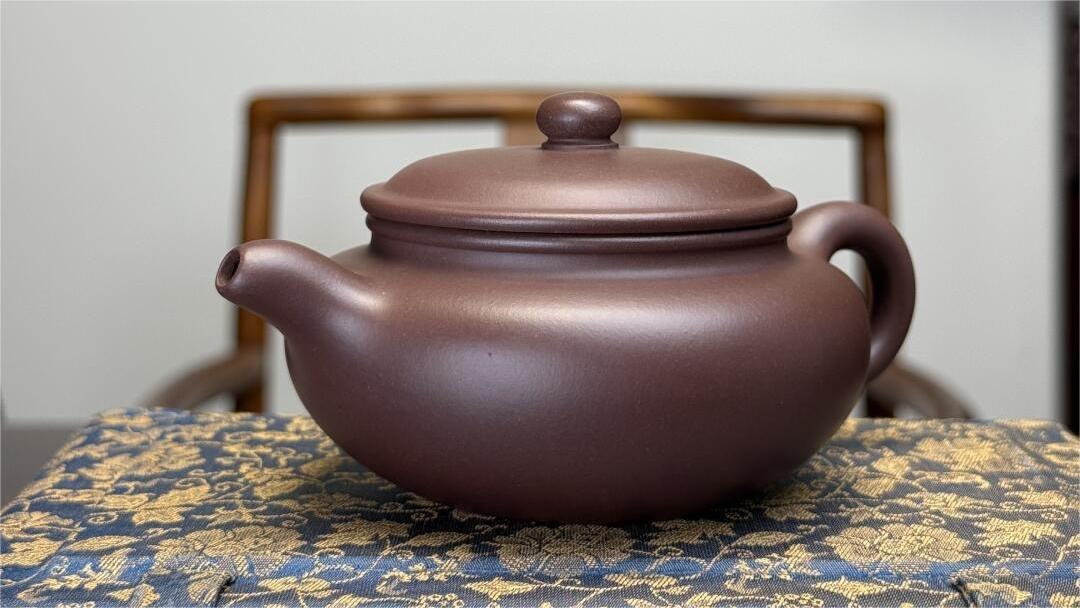
Alternatively, when brewing broken tea or ripe pu-erh, you can temporarily slip a thin layer of cheesecloth over the spout opening (and remove it after brewing) to effectively keep leaf fragments from entering the spout. Or simply use a teapot with strainer in a net or ball-hole style for broken tea, which is much more hassle-free than a single-hole pot.
If the spout is too narrow or the bend angle is too sharp, try adjusting the angle at which you tilt the pot while mastering how to use a teapot smoothly—some pots need to be tilted close to 90 degrees for smooth water flow, while others only need a 45-degree tilt.
Keep Your Gongfu Teapot Pouring Smoothly
Once your teapot is clean, the next step is matching the teapot style with the right filter design—while building a 30-second rinse habit after each use. This will keep your gongfu teapot performing well for years.
Match Loose Tea to Your Filter Type
Yixing teapots typically use three classic teapot filter designs: single-hole, flat net, or hemispherical ball-hole. These three designs are suited to different tea leaf sizes.
Prioritize a ball-hole filter or dense net mesh for broken teas and ripe pu-erh; whole-leaf high-mountain oolong and rock teas suit traditional multi-hole or single-hole chinese teapots.
| Filter Type | Best Tea Pairings | Pouring & Clog Resistance |
| Single-Hole (Du Kong) | Large whole-leaf teas (rolled oolongs, Wuyi rock tea) | Fast when clear, but easily blocked by broken leaves or loose buds. |
| Flat Net / Multi-Hole (Wang Kong) | Medium-leaf oolongs, black teas, aged white teas | Balanced everyday flow; flat wet leaves can occasionally press over the holes. |
| Ball-Hole (Qiu Kong) | Broken leaves, ripe pu-erh, fine black teas | Hemispherical dome maximizes strainer surface area for faster, clog-resistant pouring. |
Spout shape matters just as much as the filter. If effortless teapot pouring is your priority, straight or gently curved spouts consistently outpour narrow S-curved designs.
For broken leaves or ripe pu-erh, a classic round pot like the Ruyi Xishi Zisha Teapot
pairs an upgraded ball-hole filter with a short straight spout and embedded airtight lid for crisp water cut-off.
While a Fang Gu silhouette like this Yixing Clay Pot For Gongfu Set combines a straight spout with an internal ball-hole system to stop loose fragments from choking the throat.
If you prefer brisk pouring speed and steady wrist control, the Shipiao Chinese Yixing Clay Teapot uses a direct-flow spout, tightly fitted lid, and ergonomic flying handle to deliver a clean, unbroken stream.
Routine Care for Purple Clay Teapots
Preventing clogs takes far less effort than fixing them. Follow this three-step habit after every session to keep purple clay teapots fresh and free-flowing:
- Empty tea leaves promptly: Never leave spent leaves sitting overnight—swollen leaves dry onto the filter holes and breed musty odors in porous clay.
- Flush both ways with hot water: Rinse the interior with clean boiling water, then pour a quick splash backward through the spout to push out hidden leaf fragments.
- Air-dry completely with the lid off: Set the pot and lid separately on a clean, breathable tea towel until completely dry before storing.
When to Upgrade Your Yixing Teapot
- Chipped or broken spout: Purple clay is stoneware, and cracks cannot be repaired on your own. Even if fixed with glue, it is not recommended for brewing tea again (risk of chemical leaching); keep it as a display piece or have a kintsugi artisan restore it.
- Inherent spout design flaws: For example, a spout that is too narrow, a bend angle that is too sharp, or an improper outlet cut angle. These physical defects cannot be fixed, so replacing your chinese tea pot for steeping is more cost-effective than trying to repair it. Testing the pour when buying helps avoid this issue.
- Chemical-clay / slip-cast pots: If the pot itself is a cheap chemical-clay imitation, poor water flow is only one of many problems—even the clay safety fails to meet standards, so replace it with an authentic yixing zisha clay teapot as soon as possible.
Before buying a yixing clay teapot, please read this guide carefully: How to Choose a Yixing Clay Teapot
FAQ
Why does my teapot spout drip?
When a teapot is poured slowly, or when the spout lip is rounded, capillary action takes effect—a phenomenon known as the “teapot effect.” As a result, the tea moves backward along the underside of the spout instead of detaching cleanly in an arc.
What makes a teapot pour well?
When using a yixing purple clay teapot, an unobstructed air vent on the lid, a clog-resistant internal filter, and a well-designed straight or single-curve spout work together to maintain steady air pressure and smooth teapot pouring.