Blog
Gong Dao Bei vs. Cha Hai: What’s the Real Difference?

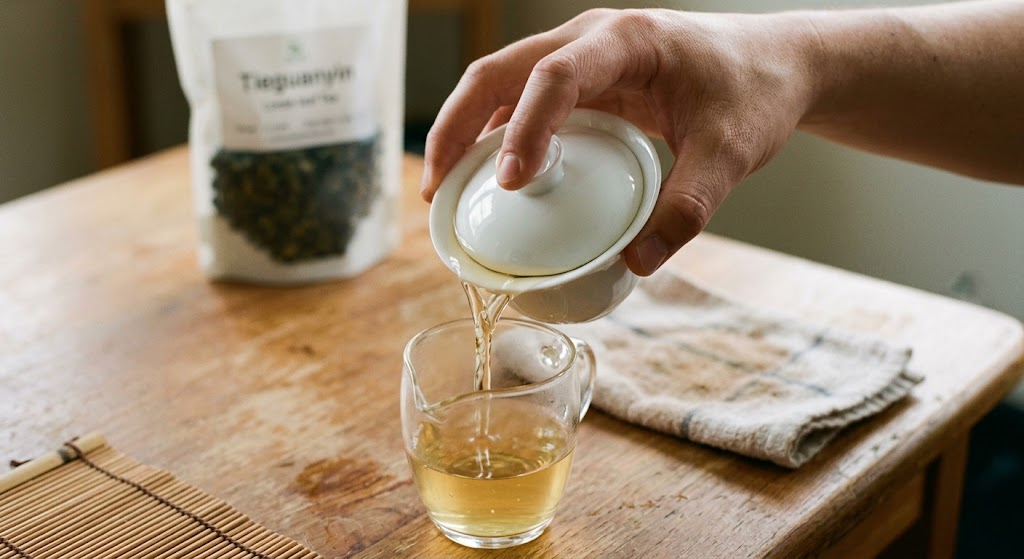
Table of Contents
For beginners, the two concepts most easily confused are “Gong Dao Bei” and “Cha Hai”. Although both refer to tools used to adjust and equalize the strength of tea liquor, their origins and cultural connotations differ.
Whether you are looking to master the brewing techniques of Gongfu tea or simply want to avoid bitter-tasting loose leaf tea, understanding the subtle differences between a Gong Dao Bei and a Cha Hai serves as an excellent starting point.
The Essential Role of the Tea Pitcher in Gongfu Cha
Why You Need a Pitcher for Brewing Loose Leaf Tea
A tea pitcher can balance the concentration of tea liquor, ensuring that every cup poured has an identical flavor consistency.
The strength of tea varies across different infusions. In fact, even within the exact same brew, tea poured out at different moments has varying concentrations.
To give a specific example, because tea poured out at the seventh second has a longer steeping time, the tea from the first second and the tea from the seventh second of the same brew have different concentrations.
A Gong Dao Bei holds the tea poured over these seven seconds, neutralizing the tea liquor concentration to make it more balanced and uniform.
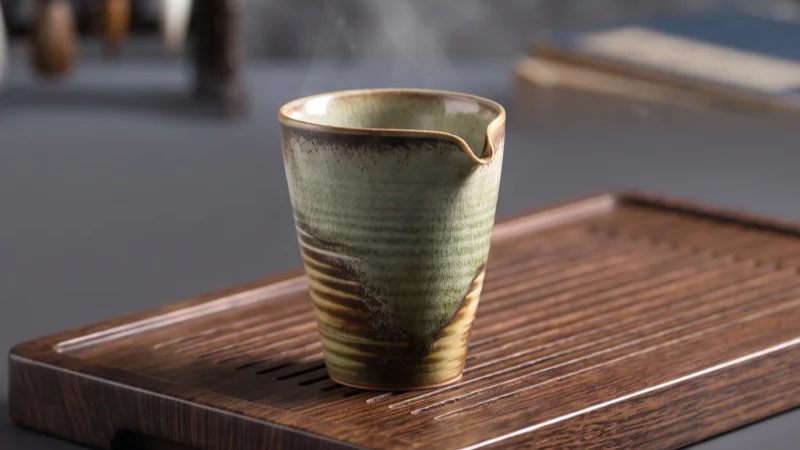
For daily brewing, vessels like the Wood Fired Reactive Glaze Pitcher are ideal. Crafted using traditional wood-fired techniques, its unpredictable kiln firing creates a striking crystalline green reactive glaze on the top, contrasting with a rugged, hand-thrown clay body below.
How It Prevents Over-Steeping and Bitterness
Brewing tea requires precise control over steeping time to regulate tea liquor strength.
When using a fairness pitcher, the tea liquor in the teapot can be poured out completely all at once, and then sub-poured into individual teacups.
According to culinary experts at Food Network, over-steeping releases excessive tannins, which not only mask the delicate flavor nuances of the leaves but also impart a dry, bitter mouthfeel similar to red wine.
This process not only allows the tea leaves in the teapot to stop steeping, preventing bitterness caused by over-extraction,
but also uses the buffering effect of the tea pitcher to flexibly adjust the pouring speed, accommodating various scenarios (such as multi-person tasting or slow, mindful sipping).
For more: The Best Guide on How to Make Tea in a Teapot
What is a Gong Dao Bei (Fairness Cup)?
The Philosophy of “Fairness” in Chinese Tea Ceremonies
A Gong Dao Bei is also known as a tea cup, equalizing cup, or justice cup. Originally, it was not used as a tea utensil, but rather as a drinking vessel for wine.
It originated from the “Nine Dragons Fairness Cup” crafted by imperial kilns in Jingdezhen under the order of Emperor Zhu Yuanzhang during the Ming Dynasty.
The Gong Dao Bei was adopted as teaware during the 1970s when tea arts surged in Taiwan. People discovered that alongside traditional teawares, an extra vessel was needed to hold the brewed tea, neutralizing the liquor to ensure that the taste strength poured into everyone’s cup was uniform, fair, and just.
The earliest Gong Dao Bei lacked an “eagle spout” at the rim, making the water prone to sliding sideways and spilling during pouring. Later, to prevent this issue and make pouring easier, the “eagle beak” shape was added.
Common Gong Dao Bei Materials: Glass, Porcelain, and Zisha Clay
Glass Gong Dao Bei: Made of glass material, featuring high transparency, easy cleaning, high temperature resistance, and environmental safety.
Ceramic Gong Dao Bei: Made of ceramic material with a delicate, warm texture, good heat retention, and rich cultural charm.
Zisha Clay Gong Dao Bei: Crafted from Zisha purple clay, offering excellent heat retention, unique breathability, even heat dissipation, unique absorption properties, and rich minerals.
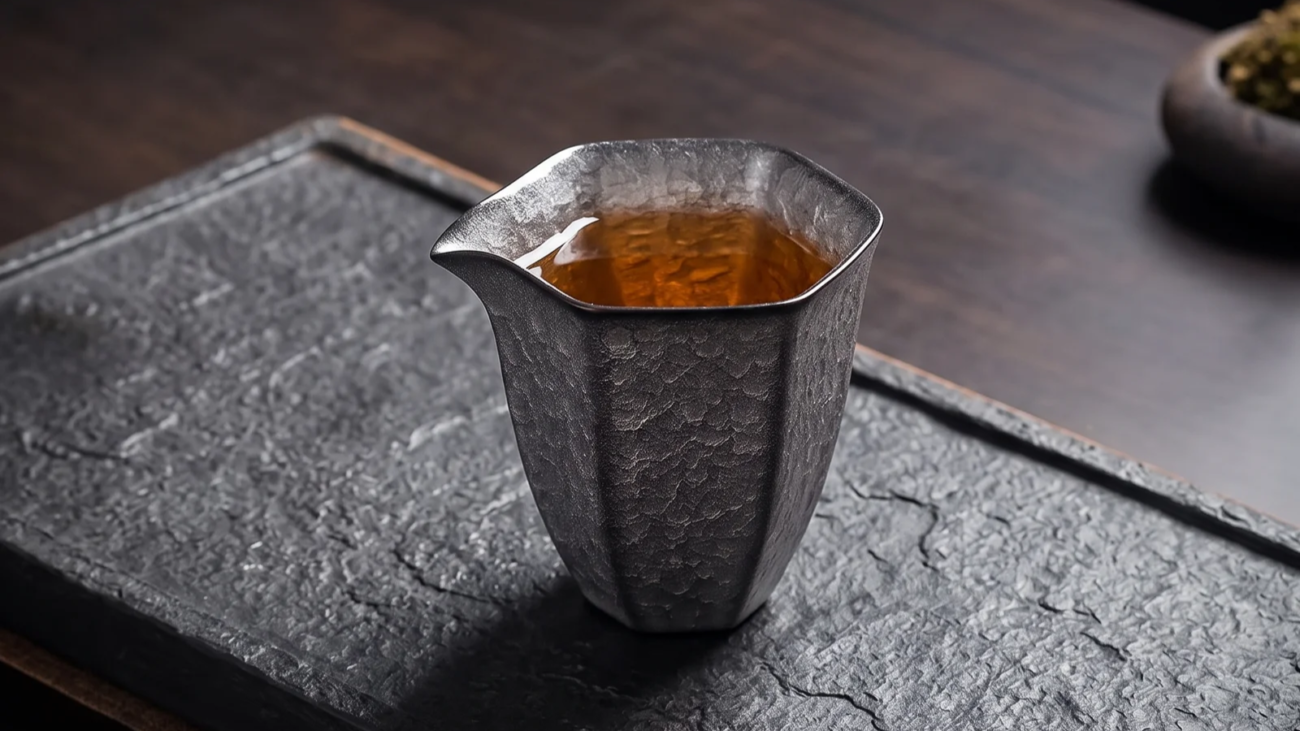
For a dynamic visual delight, the Black Ice Crackle Glaze Gong Dao Bei elevates the experience. In its dry state, the dark porcelain boasts an understated sophistication. However, once hot tea is poured in, the surface reacts instantly to the temperature, revealing intricate, rose-petal-like ice crackle patterns.
Unpacking the Meaning of Cha Hai (Sea of Tea)
Taiwanese vs. Mainland Chinese Tea Terminology
Although the term “Gongfu tea” is widely useTaiwanese vs. Mainland Chinese Tea Terminologyd in Mainland China, in Taiwan people prefer to call this concept a “Cha Hai”.
During the popularization of Gongfu tea culture in Taiwan, everyday tea drinking was elevated into an elegant art form, creating the “dry-style” tea ceremony. In this context, the tea pitcher acts like a vast “sea” receiving the rivers of tea flowing from the teapot.
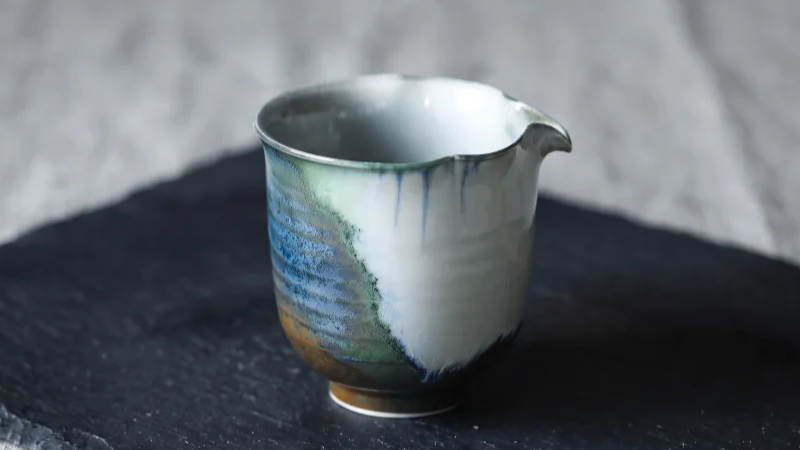
Pieces like the Soda Fired Aurora Crackle Chahai perfectly encapsulate this artistic elevation.
Utilizing the intricate soda firing technique, the glossy white glaze on one side cascades like untouched snow, meeting a deep blue-green aurora transition on the other.
Where the glazes meet, ethereal crystalline drips form.
Over time, the white glaze develops a beautiful ice-crackle patina as tea residue permeates the microscopic lines, transforming the Chahai into a personalized vessel of memories.
Does Cha Hai Also Mean Tea Tray?
This is a common point of confusion for beginners when searching online.
In certain specific traditional contexts, “Cha Hai” can also refer to large slatted wooden or bamboo tea trays equipped with a drainage system (nowadays more commonly called a “Cha Pan”).
However, in modern English-speaking countries, when people use the term “Cha Hai”, it almost always refers to a tea pitcher.
The Main Difference Between Gong Dao Bei and Cha Hai Explained
Interchangeable Terms or Distinct Teaware?
Functionally speaking, there is no difference between the two.
These two terms actually refer to the exact same type of utensil used for holding and evenly distributing tea water. The distinction stems purely from regional linguistics and cultural traditions.
If you plan to purchase a tea pitcher, the terms “Gong Dao Bei” and “Cha Hai” can be used interchangeably.
Quick Summary Table
| Feature | Gong Dao Bei | Cha Hai |
| English Translation | Fairness Cup / Justice Cup | Sea of Tea / Tea Pitcher |
| Primary Region | Mainland China | Taiwan |
| Historical Origin | Ming Dynasty (originally for wine) | 1970s-1980s (Tea arts revival) |
| Function in Gongfu Cha | Equalizes tea strength & stops steeping | Equalizes tea strength & stops steeping |
FAQ
Can I brew Gongfu tea without a Gong Dao Bei?
Yes, but you must pour the tea in a continuous, overlapping circle directly into the guests’ cups (the “wet” method) to ensure the strength is evenly distributed without a pitcher.
What size Cha Hai should I buy for my gaiwan?
Always choose a Cha Hai that is slightly larger than your brewing vessel; for example, a 200ml pitcher is perfectly sized to comfortably hold the liquid from a 150ml gaiwan without spilling.